
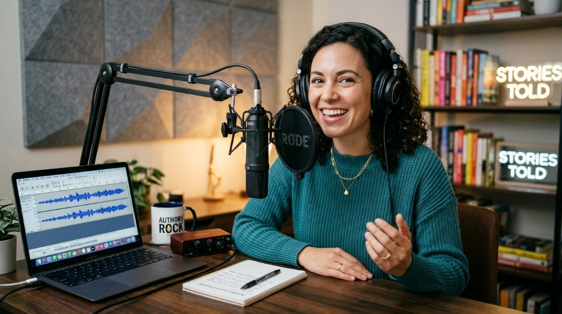

Audiobooks provide writers with an additional platform for connecting with readers who like to listen rather than read. Sites like Audible provide professionally recorded books for a wide range of listeners, although producing an audiobook requires more than just putting an audio file up on the site. Writers must prepare the manuscript, record the book properly, satisfy technical specifications, generate proper metadata, and pick the right means of distribution. Learning about the stages of this process
can facilitate it greatly.
What Do You Need Before Publishing an Audiobook?
Before releasing an audiobook, the writer must first finish his/her manuscript, acquire an appropriate narrator, get a professionally edited audio version, and have correct book details. The manuscript must already be proofread because making changes to it once the narration is done will need costly re-recording.
The writer should also know whether he/she will be narrating the book himself/herself or seek help from a professional narrator. Self-narration may be possible for certain books that are not fiction but professional narration will be more consistent and pleasant to listen to.
How Do You Prepare a Manuscript for Audio Production?
A manuscript needs to be adapted carefully for spoken delivery. Text that looks effective on a printed page may not always sound natural when read aloud. Long sentences, complicated formatting, tables, footnotes, and visual references may require adjustments so listeners can understand the information without seeing the original page.
Authors should also identify names, technical terms, abbreviations, and foreign words that could create pronunciation problems. Creating a pronunciation guide before recording can help the narrator maintain consistency throughout the audiobook.
How Do You Choose the Right Narration Option?
The narration style should match the book and its intended audience. Authors can either narrate the audiobook themselves or work with a professional narrator. Professional narrators may bring experience in character voices, pacing, emotional delivery, and microphone technique.
For fiction, different characters may require distinct vocal approaches, while nonfiction generally benefits from a clear and authoritative delivery. Before selecting a narrator, authors should review samples, discuss the expected tone, and confirm the production schedule. A clear agreement should also explain payment, revisions, ownership, and distribution rights.
See also: How to Research a Career Before Pursuing It
What Is the Difference Between Self-Narration and Professional Narration?
Both options are possible, but each one has its own set of conditions. The following comparison will enable authors to determine what works better for their project.
| Factor | Self-Narration | Professional Narration |
| Initial control | High | Shared with narrator |
| Voice consistency | Depends on author | Professional management |
| Production experience | Author has to gain it | Narrator has experience |
| Recording setup | Author prepares it | Managed by production team |
| Editing | Requires separate help | Part of production |
| Best choice for | Memoir projects, personal ones, author’s narration | Commercial, fiction, nonfiction |
However, regardless of whether an author decides to record the audio book alone or order the professional narration, high-quality sound is crucial.
How Do You Produce and Edit the Audiobook?
Once narration is complete, the recording should go through a careful editing and quality-control process. Editors remove unwanted noises, excessive pauses, mistakes, and technical problems while maintaining natural pacing.
The final files also need to meet the technical specifications required by the selected distribution platform. Authors should check audio quality, file organization, chapter order, opening and closing sections, and metadata before submission.
This stage is especially important for authors exploring Audiobooks publishing in Canada, because professional production standards can influence how the finished audiobook is presented to listeners. Working with experienced publishing professionals can help authors manage recording, editing, formatting, and distribution requirements more efficiently.
How Do You Publish an Audiobook Through Audible?
In most cases, authors must use an authorized audiobook distribution channel to allow their books to be distributed via Audible. One of the widely utilized methods is that of using the audiobook publishing platform of Amazon via ACX, depending on the author’s geographical location and eligibility.
The procedure involves the creation of an account when necessary, submission of the information regarding the audiobook, upload of necessary audio and cover file, review of the project information and submission of the same. The system thereafter validates the book against its requirement.
The title, author’s name, narrator, the category, and description are some of the key elements that authors have to ensure that they are correct.
How Does KDP Relate to Audiobook Publishing?
KDP, or Kindle Direct Publishing, is primarily associated with publishing Kindle eBooks and print books through Amazon. Audiobook publishing follows a separate production and distribution process, although authors can coordinate their Kindle, print, and audiobook editions as part of one publishing strategy.
Maintaining consistent titles, author information, descriptions, and branding across Kindle, print, and audio editions can make the overall publishing experience more organized. Authors should also check whether their audiobook can be connected with the corresponding Amazon book editions after publication.
What Should Authors Check Before Submission?
A final quality-control checklist can prevent avoidable delays. Authors should verify that:
- The complete manuscript has been narrated.
- Chapter titles and order are correct.
- Audio files meet the required technical standards.
- Narration is clear and consistent.
- Background noise and recording errors have been removed.
- The cover follows the platform’s specifications.
- Metadata and book descriptions are accurate.
- Narrator and author credits are correct.
- Publishing and distribution rights are properly confirmed.
Authors who are looking for professional assistance can also explore publishing companies and service providers that understand the audiobook production process. Choosing experienced support can be particularly useful when an author wants to coordinate editing, narration, design, and distribution rather than managing every stage independently.
When Should You Consider Professional Publishing Support?
Professional help is valuable when the writer lacks recording tools, narrating skills, editing techniques, or distribution needs. A publication team can assist in coordinating various processes and addressing any technical difficulties prior to submission.
For authors researching a publishers house Canada option, it is important to review the specific services offered rather than assuming every publishing company handles audiobook production. Authors should ask whether narration, audio editing, cover design, metadata preparation, distribution, and post-publication support are included.
Where Can You Get Help With Audiobook Publishing?
Book Publisher Canada can help writers with their queries at various stages of the production and publication process for books. Prior to selecting a service provider, the author must determine what is covered in the work, time taken for production, ownership rights, revisions, and distribution.
Final Thoughts
Creating an audiobook for Audible involves preparation, high-quality narration, editing, good metadata, and meeting the requirements of the distribution process. The author will need to start off by preparing a finished book, choose the right narration technique, pass through all quality checks, and finally choose the right channel for distribution. This way, the author treats the whole process of creating an audiobook as a whole process of publishing, not just uploading audio content.
